Register here: https://form.jotform.com/251057911151045
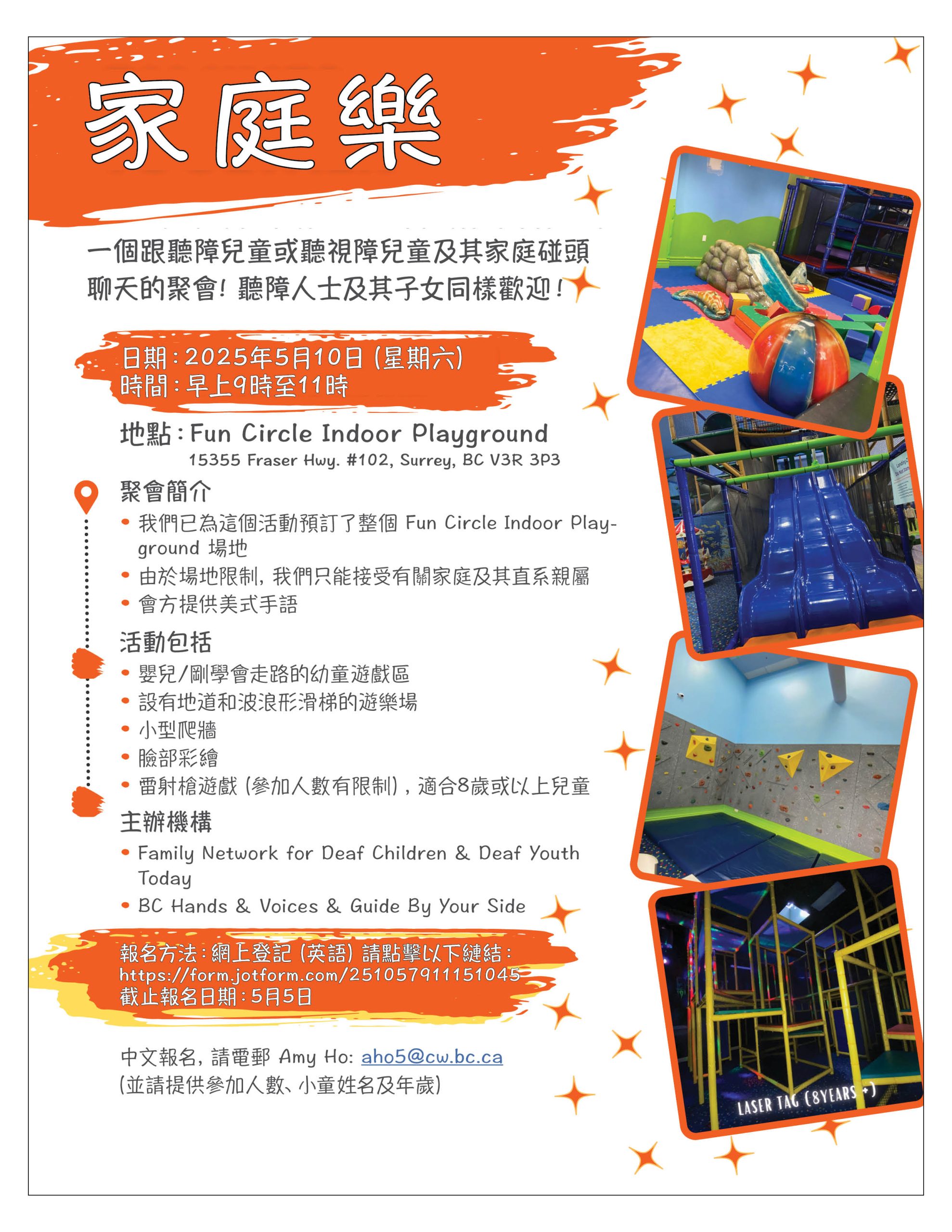
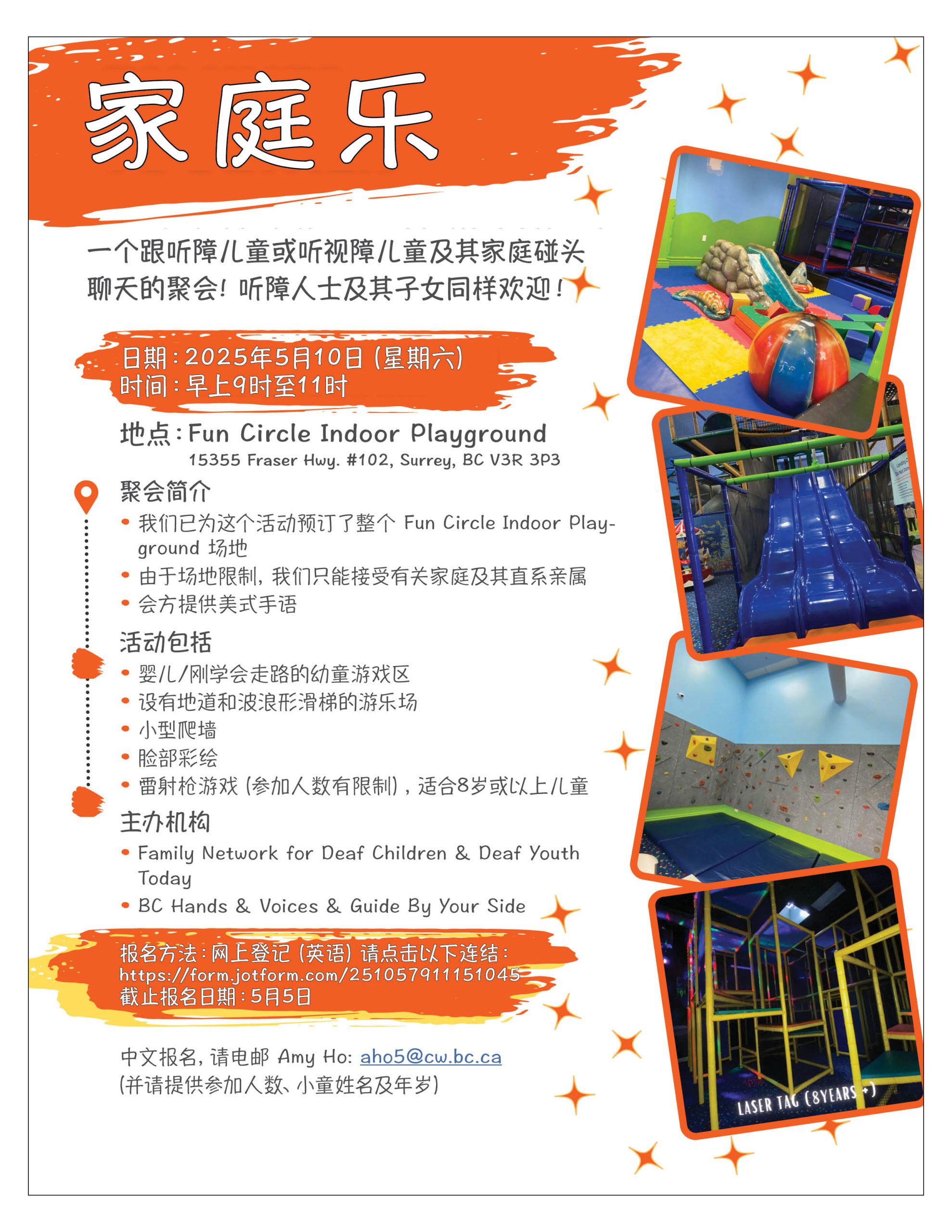
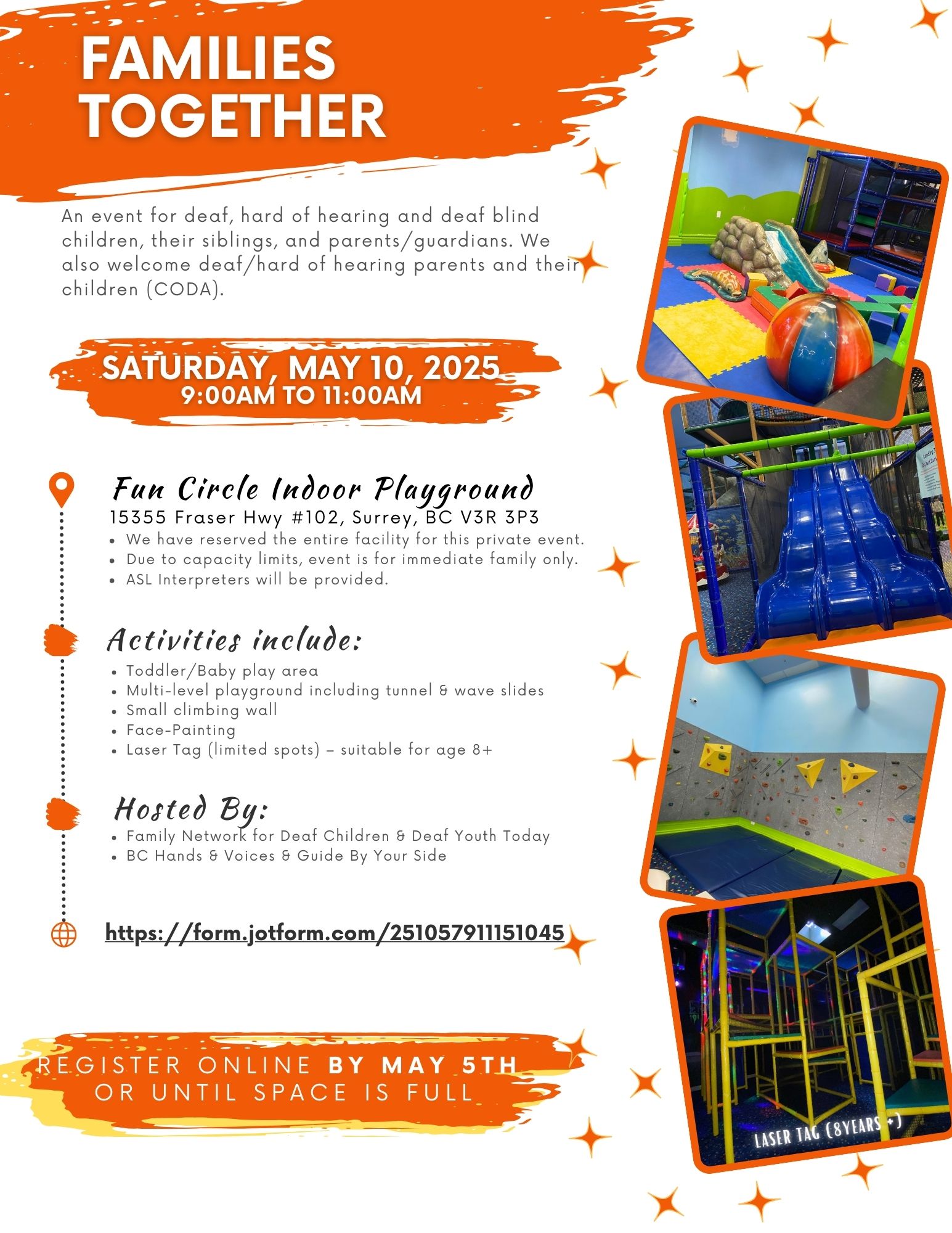
WHO:BC Hands & Voices, Guide By Your Side, Family Network for Deaf Children, Deaf Youth Today
WHAT: Plan to join us on the morning of Saturday, May 10th for this event bringing families with deaf/hard of hearing children together to play and socialize. An event for all ages.
There is a soft play area for little ones under 2 years, a climbing area with multiple slides for those over 3, a small indoor climbing wall and laser tag for those over 8. More info to come!
This event is a wonderful opportunity to mix & mingle with other families with kids of all ages and with youth/young adults who are deaf/hard of hearing.
WHEN: Saturday May 10th, 9:00am-11:00am
WHERE: Fun Circle Indoor Playground – 15355 Fraser Hwy #102, Surrey
CONTACT/INFO: email brianne@fndc.ca and register here: https://form.jotform.com/251057911151045
Please register by May 5th or until capacity is reached.
Download the flyer here: FunCircle 5.10.2025
By Kim Shauer
We recently held our Annual General Meeting (AGM), an evening filled with reflection, connection, and inspiration. A standout highlight of the event was the Youth Panel, where five remarkable young people who are deaf and hard of hearing (DHH) shared their personal experiences, challenges, and advice.
Sharing Their Journeys
The panelists spoke candidly about their lives growing up with a hearing difference. They described their use of various hearing equipment — including hearing aids, cochlear implants, bone-anchored hearing aids (BAHAs), mini-mics and Roger microphones — and how these devices help them navigate their environments. From managing noisy classrooms to advocating for themselves with teachers and friends, each panelist emphasized the importance of communication and self-advocacy.
Engaging in Extracurricular Activities
It was inspiring to learn about the wide range of activities these young individuals are involved in. Some pursue dance, martial arts and sports, while others enjoy music, building model planes, and creating art. They explained how they adapt to ensure accessibility — whether by using American Sign Language (ASL) interpreters for swimming lessons, having coaches use mini-mics, and speaking up when they need instructions repeated. Their adaptability and resilience shone through in every story.
School Experiences and Self-Advocacy
The panelists also shared their school experiences, discussing how they communicate with teachers, classmates, and friends. Some attend their neighbourhood schools in a mainstream environment in hearing classrooms, others are part of BC School for the Deaf, learning from Deaf teachers in an ASL immersive environment, and another balances both by taking classes in different environments. They spoke about various preferences for using educational microphones such as having the teacher’s voice through the mic amplified in one hearing device and leaving the other device available to listen to input from other students. Most took the opportunity to educate their peers about their hearing equipment. It was clear that each young person has developed strong self-advocacy skills — asking for support when needed and confidently explaining how others can best communicate with them.
The Importance of Community
A common thread throughout the discussion was the importance of connecting with other DHH peers. Many of the panelists build friendships through BC Hands & Voices events, at the BC School for the Deaf, and through activities set up by other programs and services like ASL competitions or DHH community beach days. They expressed how comforting it is to be in spaces where communication barriers are minimal and everyone understands their experiences.
Parental and Community Support
The panelists acknowledged the vital role their parents and teachers play in supporting their journeys. From advocating for interpreters at events to learning ASL, their families have worked hard to ensure they have the tools and resources needed to succeed. The young people also recognized the value of community organizations, like BC Hands & Voices, for providing opportunities to meet others and share experiences.
Looking Ahead
The evening ended on a powerful note, with the panelists reflecting on what they want others to know about them. They expressed pride in their identities as Deaf or hard of hearing individuals, reinforcing that their hearing differences do not limit their potential. They can do anything their hearing peers can — sometimes in different ways, but always with determination and creativity.
A heartfelt thank you to our youth panelists for their honesty and bravery in sharing their stories. You inspire us all. Thank you as well to everyone who attended and continues to support our mission of building a strong, inclusive community for deaf and hard of hearing children and their families.
By Joy Santos
My daughter, Teanna, participated in her first American Sign Language Literary Competition when she was in the 4th grade. She has been a student at the BC Provincial School for the Deaf since Kindergarten. “Flying Hands” is an American Sign Language Competition that is hosted annually by the Washington School for the Deaf, where elementary students from Deaf Schools in the United States and Canada are encouraged to join.
I accompanied her on her first out-of-province trip to support her and be a part of the audience, and, to my delight, it was here that I was introduced to the world of visual literature. We are from the Philippines, and if there is one well-known fun fact about Filipinos, it is how enjoyment in showcasing talents through performance is deeply ingrained in our culture. Be it karaoke, dance, skits, recitations, and the like, you can always expect to see something as a form of entertainment at any Filipino gathering.
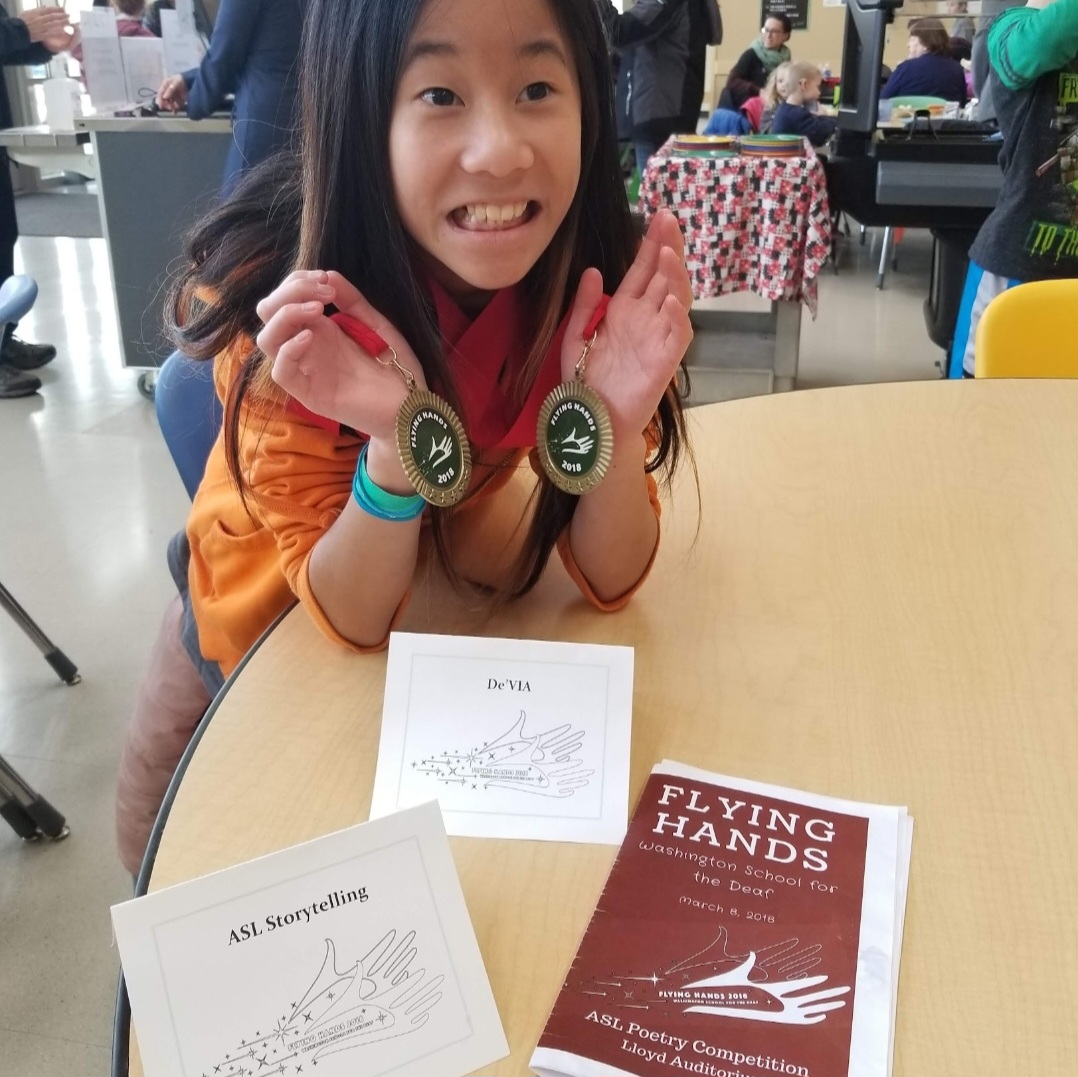
When Teanna was first identified as Deaf in 2008, one of the many things I was curious about was if there was such a thing as Deaf performance. Through my journey of raising her, I learned about the different types of Deaf literature. There are, of course, written works and signed presentations or narratives. What was new to me were the ways storytelling and poetry could be presented in Sign Language.
Some categories of visual literature I’ve seen are:
ASL literature has been taught in Teanna’s ASL/Deaf Studies classes throughout her school years. She and her classmates are given opportunities to develop their ASL literary skills. Students are informed of upcoming competitions they can participate in.
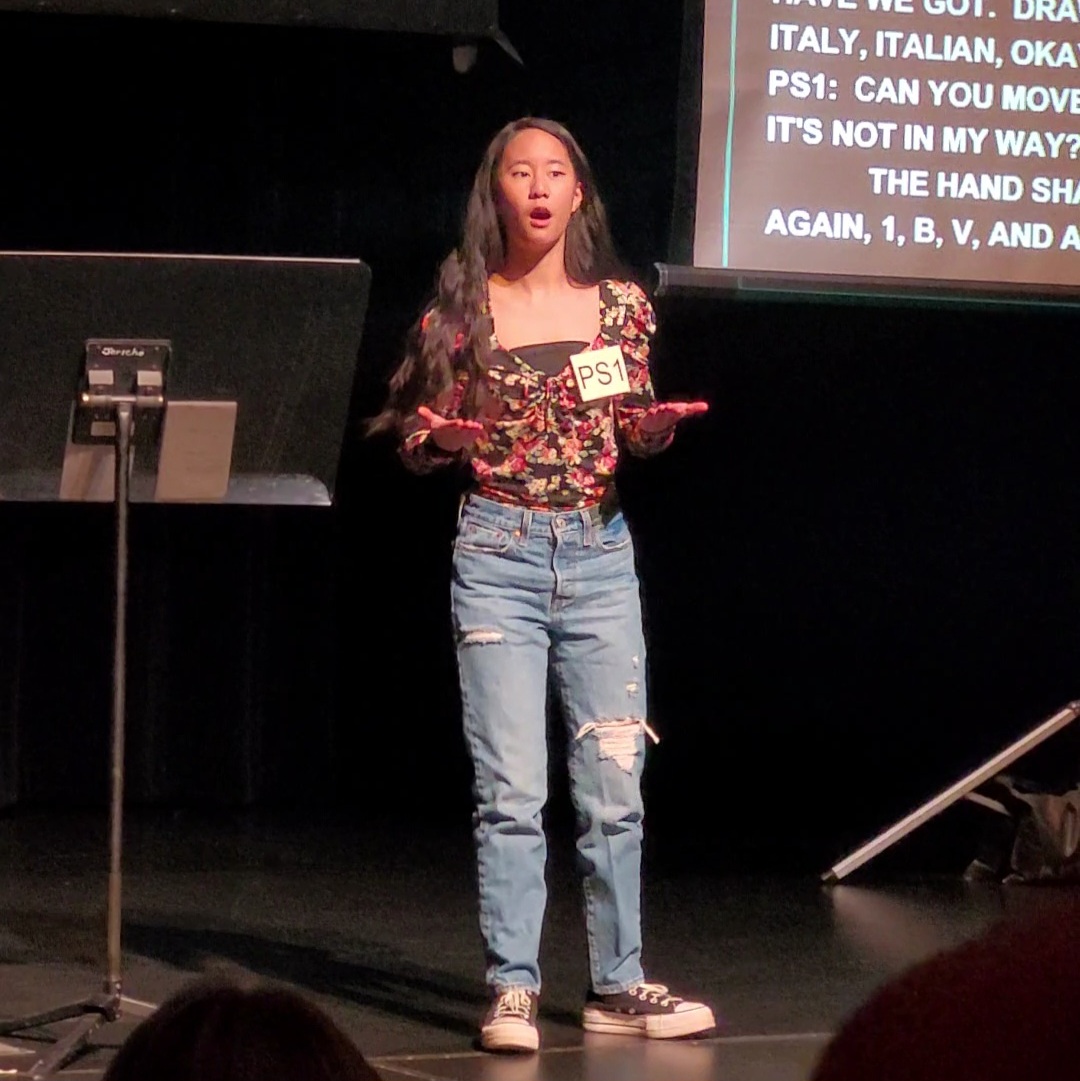
There is an annual competition hosted by the Provincial Outreach Program: Deaf and Hard of Hearing (POPDHH) called the DHH Proud Showcase. Deaf and Hard of Hearing students from across BC, in both Deaf programs and mainstream schools, are invited to participate. Competition categories usually include presentations (both ASL and oral modalities are accepted), ASL poetry, and DHH art. This event is one that DHH students seem to look forward to each year, as they are able to connect with each other in person, socialize, and form new friendships. It concludes with a “Friendship Day” which is a group field trip to a local attraction.
Another competition that Teanna has been involved in is Gallaudet University’s National Literary Competition. This is held annually, and is open to Deaf students from grades 2-12 across Canada and the United States. Each year, there is a specific theme that contestants must abide by in their submissions. Categories include both ASL and written components.
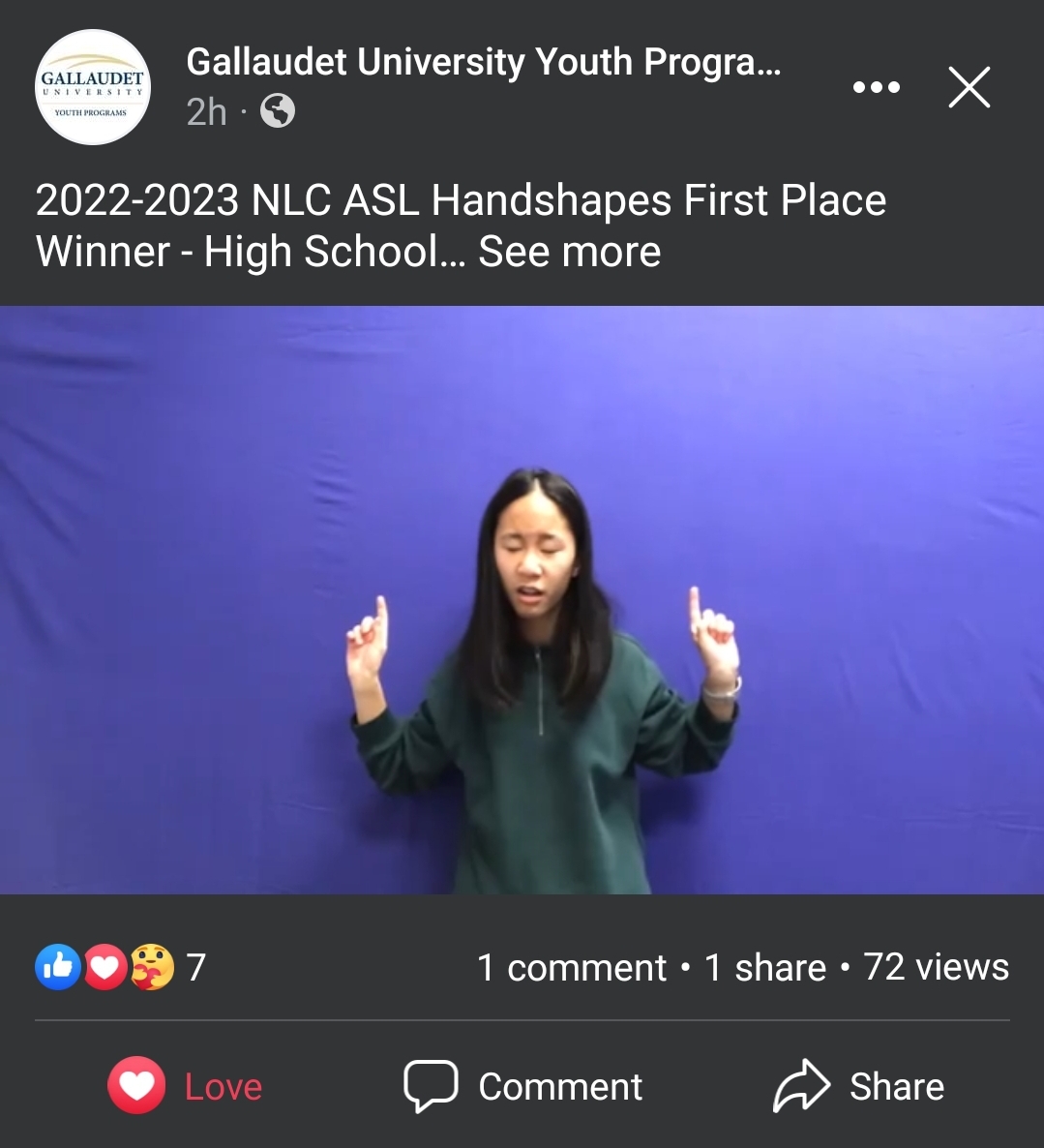
I feel like my daughter’s involvement in Deaf literary competitions has not only given her a way to artistically express herself, it has also provided a way for her to challenge herself, hone in on her skills for this talent, and allow her to showcase her pride in being a Deaf person.
By Sarah Francescutti
Empathy and emotional awareness are essential skills for social interactions, helping children form meaningful connections and navigate relationships. However, for children who are deaf and hard of hearing, developing these skills can take longer. Because they may miss subtle auditory cues like tone of voice or background conversations, understanding others’ emotions and perspectives requires extra support.
As a parent of a four-year-old daughter with bilateral differing hearing levels, I am learning to navigate these challenges while embracing the joys of her journey. When I attended the Hands & Voices conference in September 2024, one session deeply resonated with me: the importance of intentionally fostering empathy and perspective-taking in children with hearing differences. Since these skills are foundational for building strong, healthy relationships, I’ve been exploring ways to help my daughter develop them effectively.
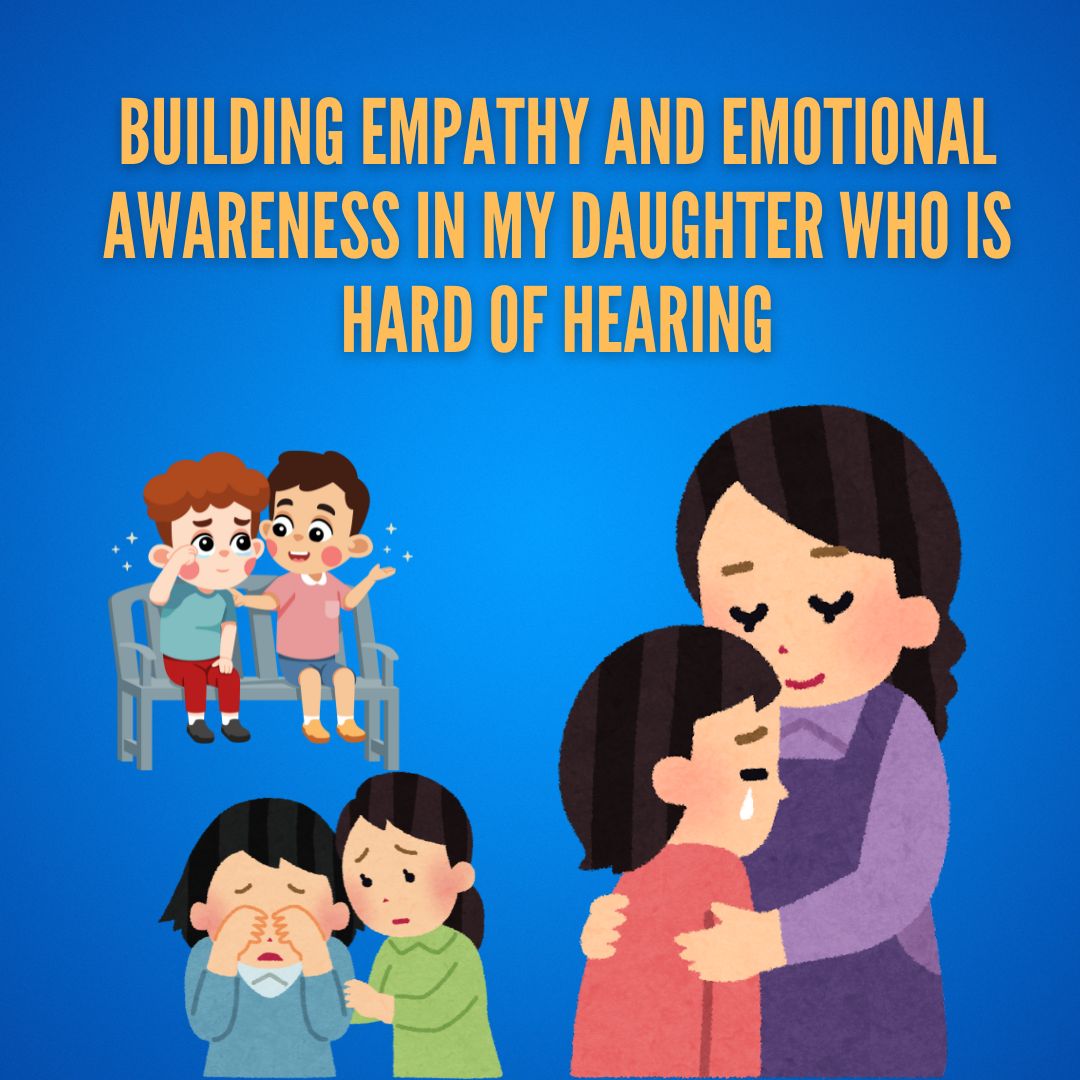
Inspired by the insights shared at the conference, I’ve been actively incorporating strategies into our daily life to help my daughter better understand her emotions and those of others. Here are some approaches that have worked for us:
Books are a wonderful gateway to emotions and perspective-taking. As we read together, I ask her questions like, “How do you think this character feels?” or “Why do you think they are sad/happy/angry?” By connecting her to the characters’ experiences, she’s learning to recognize and label emotions in herself and others. This enhances her empathy and deepens her engagement with the stories.
When my daughter is upset, we use it as an opportunity to explore her feelings. At this stage, she’s mostly using broad categories like “happy,” “mad” or “sad,” but we’ve started breaking these down into more nuanced emotions like excitement, disappointment, frustration, scared or feeling left out. The goal is to equip her with the language to express herself more fully, which, in turn, helps her better understand what others might be feeling too.
Everyday interactions provide valuable teaching moments. For instance, if she shares a toy with a friend or offers comfort when someone is hurt, we discuss how her actions might have made the other person feel. Conversely, if she takes something without asking or behaves in a way that affects others, we talk about those feelings too. These discussions are helping her connect her actions to their impact on others, fostering a deeper sense of social awareness.
Visual aids can be incredibly effective in teaching emotional awareness. Tools like an emotion wheel, which lists simple to complex emotions, can help her identify and understand a wider range of feelings. Additionally, pictures of faces showing various emotions—whether photos or cartoon representations—offer a tangible way for her to see what different emotions look like. These tools provide a visual and interactive way for her to build a stronger connection between words, expressions, and feelings.
Helping my daughter build a broader understanding of emotions—both her own and others’—is about more than just teaching empathy. It’s about giving her tools to navigate relationships, resolve conflicts, and build meaningful connections. As she grows, I hope these skills will empower her to thrive in a world that can sometimes feel overwhelming or isolating.
Parenting a deaf/hard of hearing child is a journey filled with learning, growth, and moments of profound connection. While these strategies may take time and patience, the impacts are worth it. Every effort we make to nurture empathy and emotional awareness in our children paves the way for a brighter, more compassionate future.
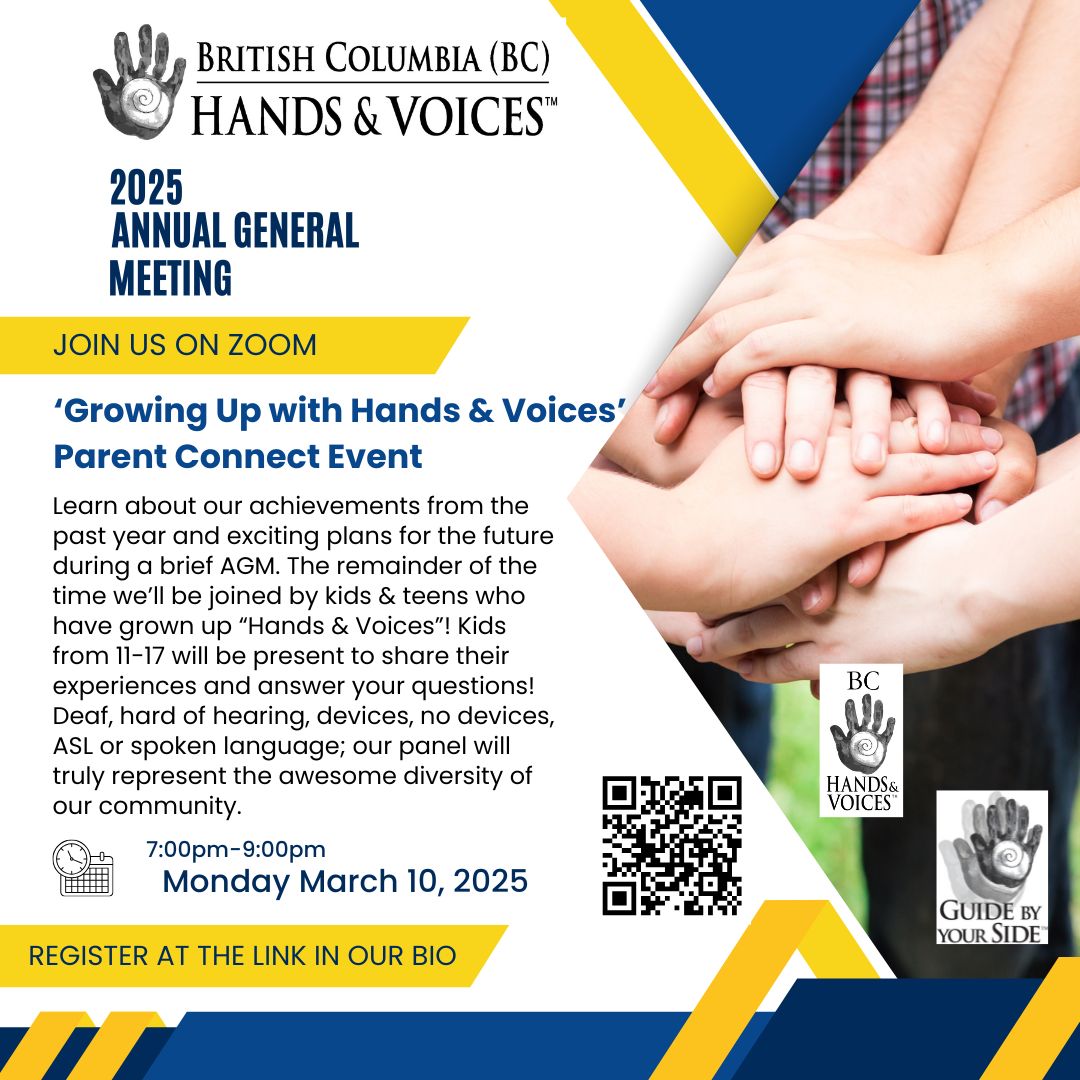 WHO: BC Hands & Voices & Guide By Your Side
WHAT: Join us for our Annual General Meeting (AGM) and special parent connect when we’ll be joined by kids & teens who have “Grown Up with Hands & Voices”! Kids from 11-17 will be present to share their experiences and answer your questions! Deaf, hard of hearing, devices, no devices, ASL or spoken language; our panel will truly represent the awesome diversity of our community.
Whether you’re a parent, professional, member, or non-member, everyone is welcome. ASL interpreters will be provided. Join us for an empowering, knowledge-sharing session to expand your perspective and feel more optimistic.
ASL Interpreters and CART captioning will be provided.
WHEN: Monday March 10, 7:00pm-9:00pm
WHERE: Zoom
REGISTER: Please register to receive Zoom details: https://tinyurl.com/
Download our full flyer here: BCHV AGM 3.2025
By: Lisa Cable
As with any non-profit organization our BC Hands & Voices Board of Directors is the heart and soul of who we are. The individuals that volunteer their time to help guide and shape the direction of our organization are incredibly important. Some of our board members are new to our team and others have been with us for many, many years.
Most of our current board members are parents of dhh kids and some are also Deaf/Hard of Hearing themselves. We’ve previously also had professionals working with dhh children as a part of our team. The one thing they all have in common is the goal of supporting and guiding the families of these children as they navigate their personal journeys.
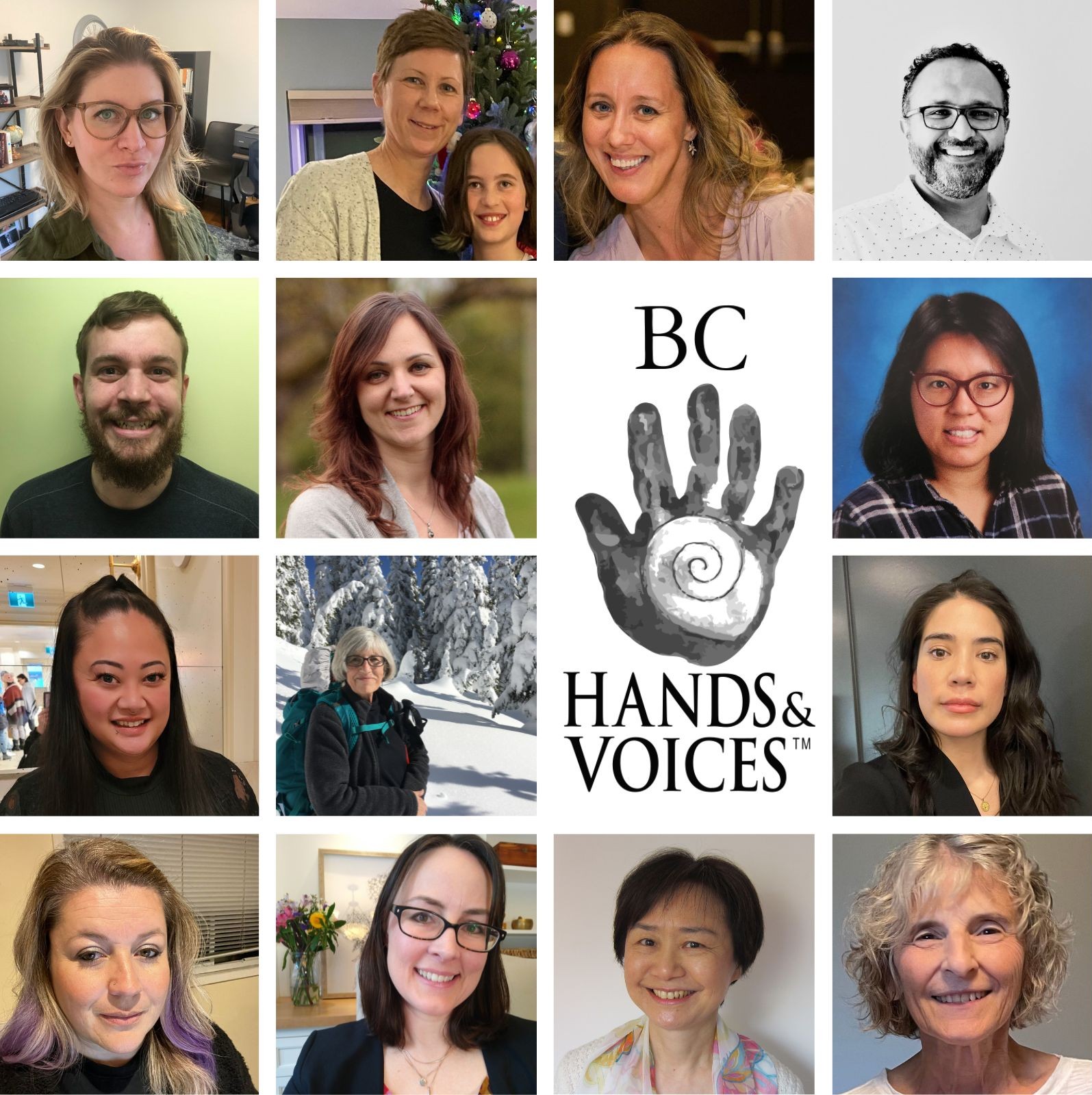
On March 10th we will be holding our Annual General Meeting (AGM). Our board of directors will be voted in for another term. In addition to the role of board director, some members will take on additional roles such as President, Vice-President, Secretary and Treasurer.
We are always looking to welcome new members to our team to help support our goals and expand our ability to reach the families of BC. In the past we’ve also had people join us as volunteers to get a feel for what the Board does and find out if it’s a good fit for them. We have a wonderful group of volunteers that manage our newsletters and articles that would welcome some new faces.
This year I will be vacating my role as President to focus on my education as I’ve returned to school full-time. This is a key role in that the President provides leadership to the rest of the team and helps plot the course for the organization. We would very much like to see this role filled at our AGM in March and are looking for 1 or 2 persons who would be interested in stepping into this position.
The role of President requires someone who has strong leadership skills, good communication abilities and who can work with a team of diverse people. The board meets virtually once a month which is about 8-9 times a year and once in person, for an annual planning meeting.
We would love to find a person or persons who are enthusiastic about working in the British Columbia DHH community and who are wanting to support families with children who are deaf/hard of hearing as the President of our Board. This is a wonderful opportunity for someone who has worked in the past with other committees or boards and is looking to volunteer and give back in some way.
If you wish to work with us but are not interested in stepping into the President role, please do reach out as we would love to connect with you. Contact us at info@bchandsandvoices.com or to me directly at lisa@bchandsandvoices.com for more information.
Editors’ Note: There are countless, beautiful ways to be a family, none is better than another. What’s important is having loving, supportive and engaged care-givers. BC Hands & Voices recognizes, supports and values all families. This article was written from one perspective, one way to support a deaf/hard of hearing child. It was written to encourage all caregivers (in whatever way that looks like for your family) to get involved.
By Zen Tharani, BC H&V Board Member
As a dad on the BC Hands & Voices board, I’ve had the privilege of connecting with many parents of deaf and hard of hearing (dhh) children. One thing that’s clear is how much love and dedication every family brings to the table, often balancing multiple priorities like work, other kids, and life’s unexpected curveballs. While dads are definitely engaged in this journey, as a dad, I have noticed there is room for us to be even more involved—and that’s something BC Hands & Voices is eager to explore.

It’s important to acknowledge that every family’s situation is different. Not everyone has the time to attend every meeting or event, and that’s okay. Advocacy and involvement can take many forms, whether it’s reading up on communication strategies, sharing a story with other parents, or finding small ways to support your child’s growth and confidence. Dads, like moms, bring their own strengths to the table, and even small steps can make a big impact.
Why Dad Involvement Matters for DHH Children
Children thrive when they see both caregivers/parents engaged in their lives, and this is especially true for dhh children. Research shows that parental involvement is directly linked to better academic outcomes, stronger social skills, and higher self-esteem in children. A Canadian study by Statistics Canada highlighted that children who receive support from both parents are more likely to feel confident navigating challenges in school and life. This is especially important for dhh children, who often face additional hurdles in communication and access.
When dads are visibly involved, they reinforce to their children that their unique needs are a priority for the whole family. Whether it’s attending a school meeting, learning sign language, or simply being present at community events, these actions communicate that dads are equally invested. For dhh kids, seeing both parents advocating for them can foster a strong sense of security and belonging. It also helps normalize their experiences, showing them they are valued and supported every step of the way.
The Broader Impact of Dad Engagement
Dad involvement isn’t just important for the child—it also strengthens family dynamics and builds community connections. Shared responsibility lightens the emotional and logistical load, creating a more balanced and resilient family environment. For many families with multiple children, this teamwork is essential to meeting everyone’s needs.
On a community level, dads who participate in advocacy or events help create a network of support for other families. Your presence might inspire another dad to get involved or share their own experiences. In fact, research from the National Responsible Fatherhood Clearinghouse in the U.S. shows that when fathers actively participate in caregiving and advocacy, they contribute to stronger family and community ties. While we need more Canadian-specific data on this topic, anecdotal evidence from parent networks suggests a similar trend here.
Finding Your Own Way to Engage
Every dad’s involvement will look different, and that’s okay. Some may have the flexibility to attend workshops or meetings, while others may support their child in quieter ways, like practicing communication strategies at home or sharing resources with teachers. The key is to find what works for your family and your schedule.
Here are a few ideas to get started:
BC Hands & Voices Wants to Hear From You
BC Hands & Voices is committed to creating opportunities for all parents to connect and engage in meaningful ways. We know that every family’s needs and circumstances are different, and we want to hear your ideas about what would make it easier or more meaningful for you to get involved.
Would you be interested in casual meet-ups? Workshops designed for dads? A space to share stories and experiences? Let us know! Your input will help us design opportunities that work for you and your family.
Email us your thoughts and suggestions at info@bchandsandvoices.com. Together, we can ensure that all parents, including dads, feel supported as they help their dhh children thrive.
Final Thoughts
Dads bring unique perspectives and strengths to parenting, and their involvement in advocating for dhh children is incredibly valuable. By being present and engaged in ways that work for your situation, you’re not just supporting your own child—you’re contributing to a stronger, more inclusive community for all dhh families. Let’s work together to find new ways for dads to connect, support, and advocate for the amazing kids we’re all raising.
We’re excited to hear from you and work together to make this happen. Thank you for all that you do—it truly makes a difference.
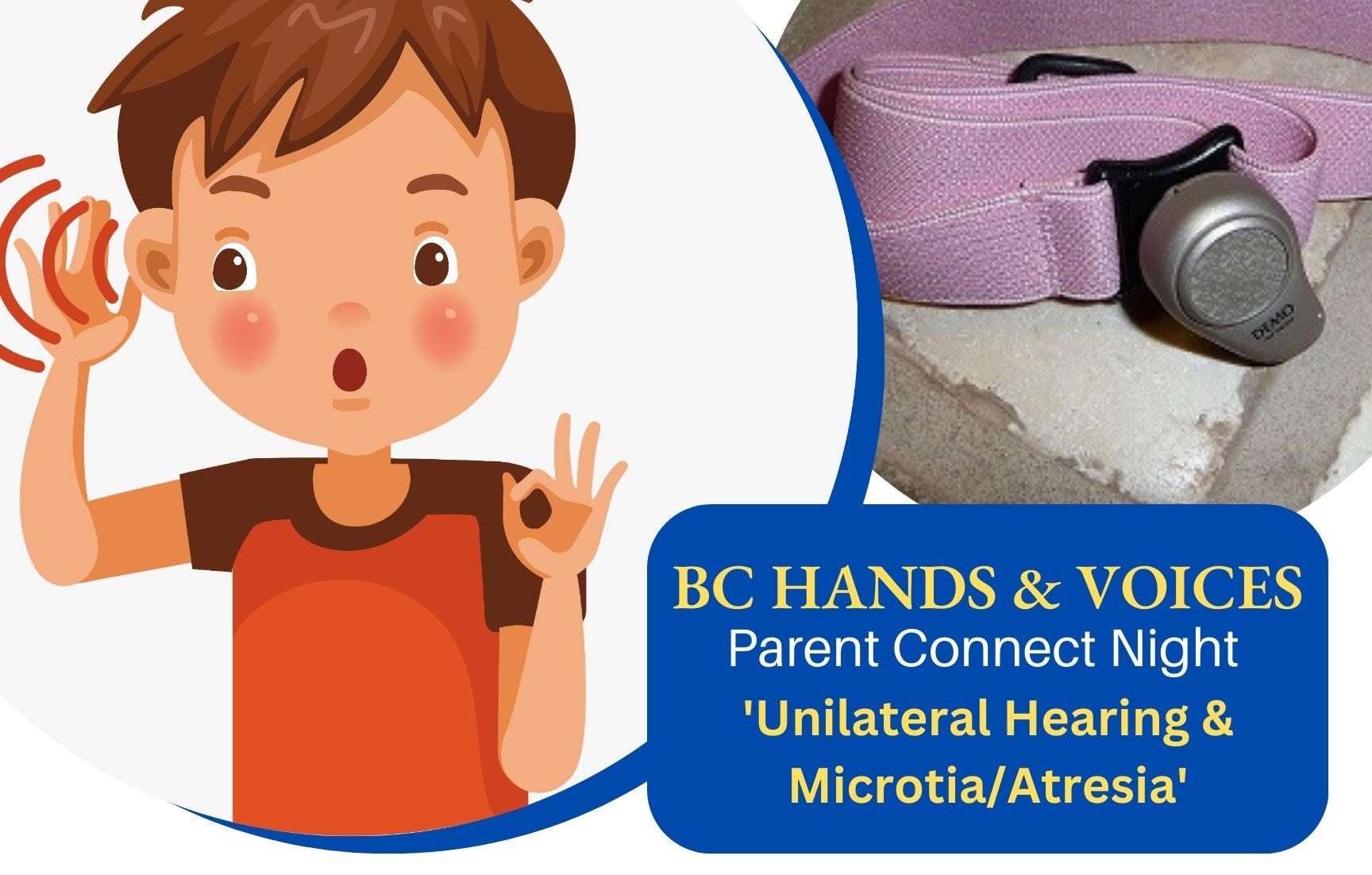
WHO: BC Hands & Voices & Guide By Your Side
WHAT: Join us for a special parent night about unilateral hearing and microtia/atresia hosted by our board member parents and guides with children who have unilateral hearing, microtia/atresia and/or use Bone Anchored Hearing Systems (BAHS). Grab a beverage and join us from your favourite spot at home! Ask questions, get tips, and share experiences with other parents.
Second Language and/ or ASL interpreters will be provided if requested by January 13.
WHEN: Monday January 27, 6:30pm-8:30pm
WHERE: Zoom
REGISTER: Please register to receive Zoom details: https://tinyurl.com/mr2stht3
Download our full flyer here:uhlma 1.2025
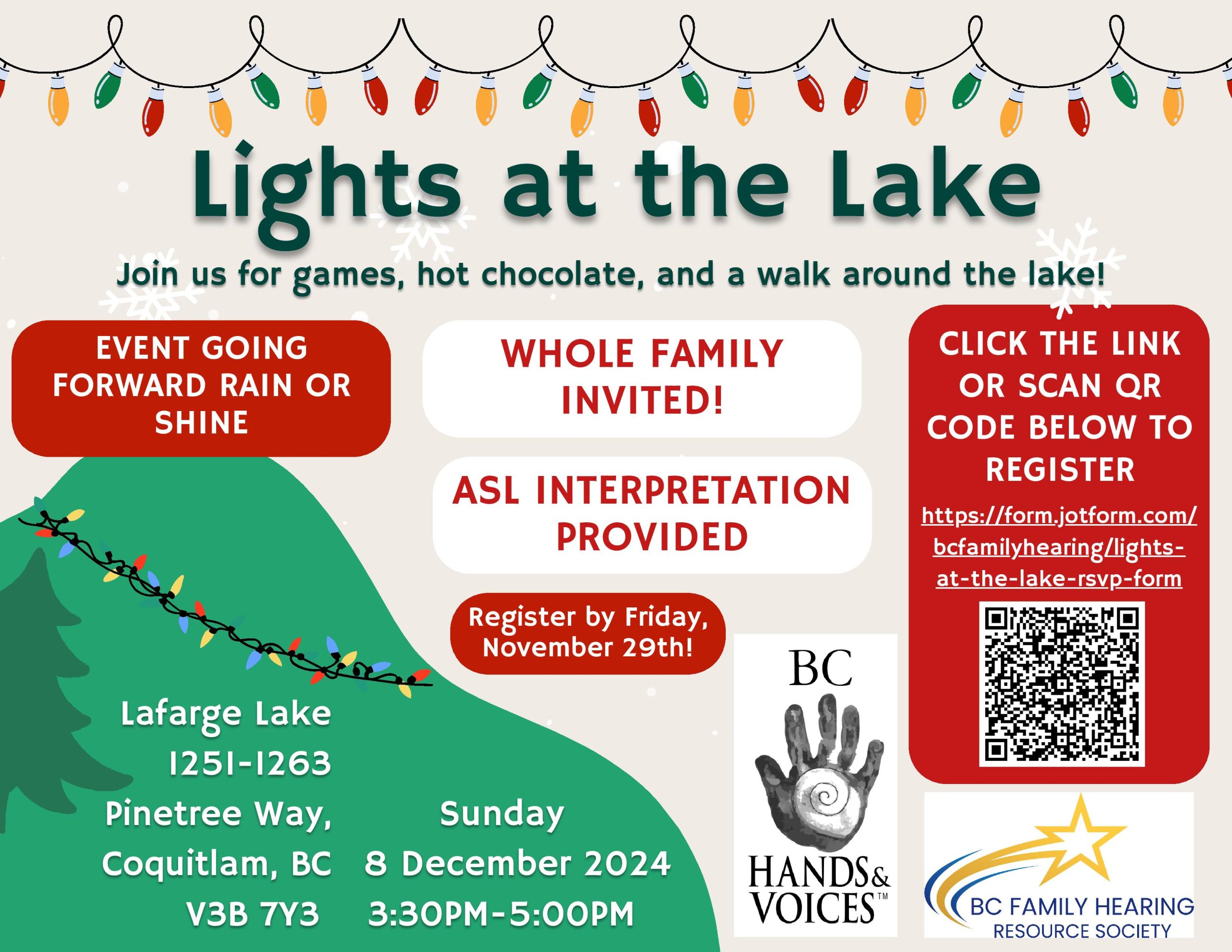
Gather the whole family and join us for games, hot chocolate, and a walk around the lake. This event is going ahead rain or shine so dress for the weather. ASL Interpreters will be present. This event is jointly hosted with BC Family Hearing Resource Society.
Registration deadline: Friday, November 29th.
https://form.jotform.com/bcfamilyhearing/lights-at-the-lake-rsvp-form